

Seamless rail welding method
With the rapid development of high-speed and heavy-load railways, the track structure has been gradually replaced by seamless tracks from ordinary tracks. Compared with ordinary tracks, seamless tracks eliminate a large number of rail joints, so they have the advantages of stable driving, low track maintenance costs, and long service life. They have become the main method for the construction of high-speed railway lines. Seamless tracks are an important new technology for railway tracks. Ordinary rails are welded into long rails of a certain length. The lines formed by welding and laying long rails of a certain length are called seamless tracks. The welding of long rails is an important part of laying seamless tracks.
At present, there are three main welding methods for seamless track rail joints: rail contact welding, gas pressure welding, and aluminum thermite welding.
Rail contact welding
Rail contact welding (flash welding) is generally used for factory welding. 95% of seamless lines are completed by this process, that is, a 25-meter standard rail without holes is welded into a 200-500-meter long rail.
The principle is to use the current to pass through the contact surface of the rail to generate heat to melt the local end face of the rail, and then complete the welding by top forging. Since the welding heat source of contact welding comes from the internal heat source of the workpiece, the heat is concentrated, the heating time is short, the welding process does not require filling metal, the metallurgical process is relatively simple, the heat-affected zone is small, and it is easy to obtain a good quality welded joint.
Gas pressure welding
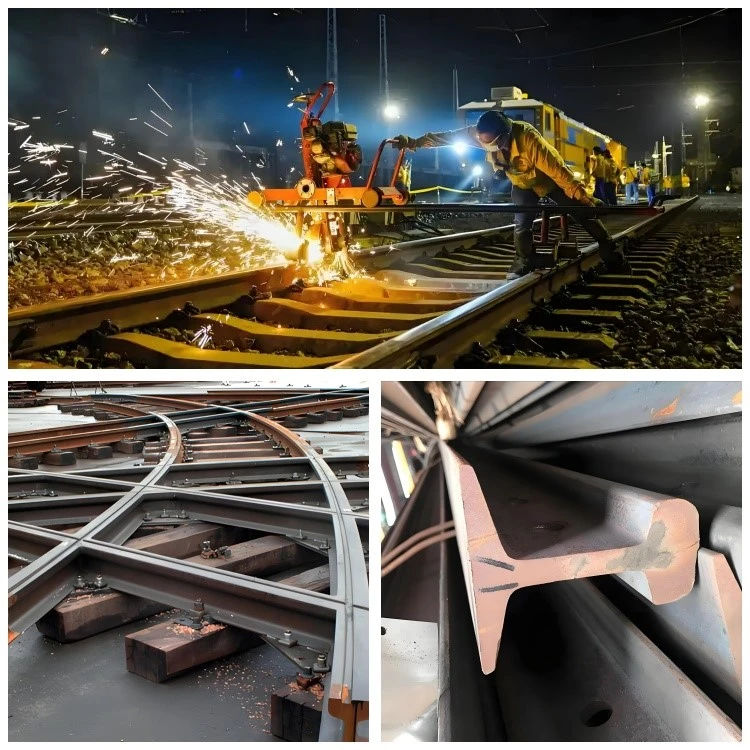
The widely used rail gas pressure welding is a small mobile gas pressure welding machine, which is mainly used for welding long rail joints on construction sites, and can also be used to weld damaged rails using a blocked skylight.
The principle is to heat the welding end face of the rail to a plastic state, and produce a top forging amount under a fixed top forging force. When the top forging amount reaches a certain amount, the rail is welded into a whole.

Thermite welding
Aluminothermic welding is generally used for on-site welding of railway rails. It is an indispensable method for line laying, especially seamless line locking and rail broken rail repair. The aluminum thermite welding of rails uses the strong chemical affinity of aluminum in the flux with oxygen under high temperature conditions. It is reduced from heavy metals and releases heat at the same time, melting the metal into molten iron, casting and welding.
Its important process is to put the prepared aluminum thermite flux into a special crucible, ignite the flux with a high-temperature match, produce a strong chemical reaction, and obtain high-temperature molten steel and slag. After the reaction is calm, the high-temperature molten steel is injected into the preheated sand mold that fastens the rails, melts the ends of the rails that have been butt-jointed in the sand mold, removes the sand mold after cooling, and promptly shapes the welded joints, so that the two sections of the rails are welded together. Although thermite welding equipment has the characteristics of low investment, simple welding operation, and good joint smoothness, its weld is a relatively coarse casting structure with poor toughness and plasticity. It is best to perform post-weld heat treatment to improve the performance of the welded joint.

In short, the quality of long rail welding should be best achieved by contact welding and gas pressure welding. The ultimate strength, yield strength and fatigue strength of contact welding and gas pressure welding can reach more than 90% of the parent material. The quality of thermite welding is slightly worse, its ultimate strength is only about 70% of the parent material, and its fatigue strength is even worse, only reaching 45% to 70% of the parent material, and its yield strength is slightly better, close to contact welding.


