

What Are Heavy Steel Rails?
Rails are classified by their nominal mass per metre. In the Chinese system, GB/T 2585 (hot-rolled steel rails for railway) covers sections from 38 to 75 kg/m; in practice 43, 50, 60 and 75 kg/m are the heavy sections used on mainline and high-speed track, while lighter sections of 8-30 kg/m (GB/T 11264) serve industrial sidings, cranes and light railways. On European networks the same role is filled by UIC 54 and UIC 60 under UIC 860, now normally specified as 54E1 and 60E1 under EN 13674-1. In North America, AREMA Manual Chapter 4 sections such as 115RE, 132RE, 136RE and 141RE are the standard heavy rails, the designations giving the nominal weight in pounds per yard.
Rail Sections and Weight per Metre
The section number is the nominal mass of one metre of rail. It is not the only specification: head width, web thickness, base width, height and the bolt-hole pattern of joint bars all belong to the section drawing, so the section must match the fastening system and the existing track components.
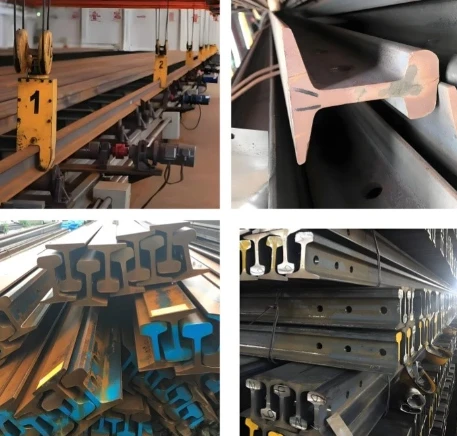
Heavy steel rail cross-section: the head, web and base geometry define the section modulus.
| Standard family | Heavy sections (nominal) | Mass per metre | Typical delivery length |
|---|---|---|---|
| GB/T 2585 (China) | 43, 50, 60, 75 kg/m | 43 / 50 / 60 / 75 kg/m | 12.5 m and 25 m; 50-100 m class by agreement (60 kg/m for high-speed lines) |
| UIC 860 / EN 13674-1 (Europe) | UIC 46, UIC 54, UIC 60 (46E1, 54E1, 60E1) | about 46.3 / 54.4 / 60.3 kg/m | typically 18-36 m as rolled; longer welded strings by agreement |
| AREMA Manual Ch.4 (North America) | 90RA, 100RE, 115RE, 132RE, 136RE, 141RE | about 44.6 / 49.6 / 57.0 / 65.5 / 67.5 / 70.0 kg/m | 39 ft (about 11.9 m) and 78 ft (about 23.8 m) |
AREMA values converted at 1 lb/yd = 0.496 kg/m.
Steel Grades and Mechanical Properties
Steel grade determines how a rail behaves under load, wear and welding. Pearlitic carbon-manganese steels dominate mainline use; vanadium micro-alloying and head hardening push hardness and wear resistance up for heavy-haul and curved track. The table below lists the grades most often specified, with minimum values taken from the cited standards.
| Grade | Standard | Min. tensile strength | Hardness | Typical use |
|---|---|---|---|---|
| U71Mn | GB/T 2585 | ≥ 880 MPa | carbon-manganese grade; hardness per standard edition, typically in the 250-300 HBW band | General mainline rails, 43-75 kg/m |
| U75V | GB/T 2585 | ≥ 980 MPa | higher hardness and wear resistance than U71Mn; per standard and heat treatment | High-speed and heavy-haul lines; also supplied as U71MnG / U75VG to TB/T 3276 for high-speed track |
| 900A | UIC 860-0 | ≥ 880 MPa | standard as-rolled carbon rail, roughly 260 HBW class (typical) | General mainline rails, UIC 54 / UIC 60 |
| R260 | EN 13674-1 | ≥ 880 MPa | ≥ 260 HBW | Mainline rails, 54E1 / 60E1; the EN counterpart of 900A |
| R350HT | EN 13674-1 | ≥ 1175 MPa | ≥ 350 HBW (head-hardened) | Curves, heavy-haul and high-tonnage corridors |
Values are the minimums stated in the cited standards. Hardness depends on grade and heat-treatment route; always confirm the current standard edition and the figures on the mill test certificate (MTC) before ordering.
Why Heavier Sections for Heavy-Haul and High-Speed Lines?
- Bending stress and section modulus
A heavier section has a larger section modulus, so under the same axle load the bending stress in the rail foot is lower and the rail deflects less. This is the core logic behind 60 and 75 kg/m rails on heavy-haul lines with 25-40 t axle loads and very high annual tonnage - for example the Datong-Qinhuangdao coal corridor in China is laid with 75 kg/m rails to survive continuous high tonnage with long maintenance intervals.
- Wear and contact fatigue
A heavier head spreads the wheel contact patch over more steel, lowering contact stress and delaying wear and rolling-contact fatigue (head checks, squats). Where curves and grades dominate, head-hardened grades such as R350HT or fully heat-treated AREMA rails give a further step in wear life at the cost of higher price and stricter welding control.
- Dynamic behaviour and ride quality
Stiffer, heavier rail reduces dynamic deflection under moving loads. Combined with continuously welded track, elastic fastening systems and regular rail grinding, this supports lower vibration and noise levels and a more stable gauge. Heavy rail alone does not "reduce noise" - the effect comes from the whole system, and heavier sections contribute by limiting dynamic movement at the wheel-rail interface.

Heavy rails in track: section, fastening and welding together control dynamic behaviour.
Manufacturing and Quality Control
Modern heavy rails are made from continuous-cast blooms, which give a homogeneous internal structure. The route is: reheating of the bloom, rolling through a universal mill that shapes head, web and base in one pass sequence, controlled cooling to avoid brittle phases and residual stress, roller straightening, and full-length non-destructive testing with ultrasonic and eddy-current equipment. Optional steps include head hardening (for grades such as R350HT) and end hardening. Every rail is then dimensionally gauged and stamped with grade, section, heat number and date. Buyers should require a mill test certificate covering chemical composition and mechanical properties per the standard, with MTC 3.1 documentation available on request; third-party inspection is a standard service at the mill.

Finished heavy rails awaiting inspection and dispatch.
Frequently Asked Questions
Q1. What does "60 kg/m rail" mean?
It is the nominal mass of one metre of rail. A 60 kg/m rail is the same product family as UIC 60 and 60E1; the actual delivered mass per metre follows the tolerances of the governing standard. The designation alone is not a complete specification - the section drawing, grade and standard must be named together.
Q2. Which grade should I choose, U71Mn or U75V?
U71Mn is the general-purpose carbon-manganese grade with minimum tensile strength of 880 MPa per GB/T 2585, suitable for most mainline applications. U75V adds vanadium, raising the minimum tensile strength to 980 MPa and improving wear resistance; it is the common choice for high-speed and heavy-haul lines. The final decision should also consider welding conditions and the project standard.
Q3. What is the difference between UIC 60 and 60E1?
60E1 is the EN 13674-1 designation for the UIC 60 profile family. The geometry is essentially the same; EN 13674-1 governs tolerances, testing and grades for deliveries within the EU framework. Outside Europe, UIC 860 remains widely used, and the two are often treated as interchangeable profile families - confirm with the section drawing before ordering joint bars or fastenings.
Q4. What lengths do heavy rails come in?
It depends on the standard: 12.5 m and 25 m per GB/T 2585, with 50-100 m class lengths supplied by agreement (common for high-speed rail); typically 18-36 m as rolled under EN 13674-1; and 39 ft or 78 ft per AREMA practice. Long welded strings are produced by flash-butt welding either at the mill or on site. State the required length band in your inquiry rather than assuming a default.
Q5. Can AREMA 136RE be replaced by UIC 60?
No. Although both are heavy rails, the section geometry - head profile, base width, height and joint-bar drilling - differs, so fastening systems, joint bars and switch components are section-specific. Always match the rail section to the existing track system; mixing sections in one track panel creates gauge and stress discontinuities.
Q6. What documentation is supplied with heavy rails?
A mill test certificate with chemical composition and mechanical results per the governing standard, MTC 3.1 documentation on request, and full traceability marking (grade, section, heat number, date) on each rail. Third-party inspection is supported at the mill before shipment.


