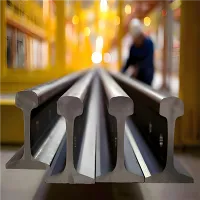
The UIC 54 rail, also known as 54E1, takes its numerical designation "54" from its nominal weight of 54.43 kg per meter, a key metric that defines its load-bearing capacity and structural profile. Manufactured in strict compliance with the technical specifications of the International Union of Railways (UIC), this rail grade is engineered to meet the rigorous demands of heavy-duty freight railways, where consistent performance under high axle loads and frequent traffic cycles is critical.
uic54 rail dimensions:

| Type of Rail | Standard | Dimensions (mm) | Section S | Mass m | ||||
| H | B | C | D | E | cm² | kg/m | ||
| European standard EN 13674-1 | ||||||||
| 54E1 (UIC54) | EN 13674 - 1 | 159,00 | 140,00 | 70,00 | 49,40 | 16,00 | 68,77 | 54,77 |
Beyond its core railway applications, the 54E1 profile has found widespread adoption in underground mining operations and industrial crane systems, thanks to its robust H-shaped cross-section, excellent wear resistance, and compatibility with standard fastening systems. Its balanced combination of tensile strength and ductility makes it suitable for environments where heavy loads, repeated impact, and harsh operating conditions are common.

Whether deployed in mainline freight corridors, mine haulage tracks, or overhead crane runways, UIC 54 rail delivers reliable structural integrity and long service life, aligning with EN 13674-1 and UIC 860 quality standards.
What material is UIC 54 rail made from?
UIC54 rail is designed to provide high strength, good wear resistance, and excellent toughness, ensuring the rail can withstand repeated heavy loads and high-speed train traffic. Common steel grades include R260, R350HT, etc,depending on project requirements and regional standards. Each grade has been tested for chemical composition, mechanical properties, and hardness, ensuring long-term reliability and safety.
The material choice directly affects the performance, durability, and wear resistance of the rail. For UIC54 rails:

R260:
- Suitable for medium-load lines and regional railways.
- Offers good toughness and cost-effectiveness.
R350HT:
- High tensile strength and wear resistance.
- Ideal for heavy haul or high-speed lines.
- Can sustain higher axle loads with less deformation.

At GNEE RAILWAY RAILWAYL, we manufacture UIC54 rail using controlled rolling techniques and multi-stage inspection, producing rails that meet the precise UIC54 rail specification for both domestic and international applications.
How Material Properties Affect Rail Performance?
The material used in UIC54 rail (54E1 rail) is one of the most critical factors that determines its long-term performance. Railway rails are subjected to continuous heavy loads, repeated wheel impact, and environmental stress. If the steel properties are not properly controlled, the rail will experience faster wear, deformation, or even cracking.

In practical railway operation, the rail head is in constant contact with train wheels. This creates high friction and cyclic stress. Over time, this leads to surface wear, internal fatigue, and structural degradation. The chemical composition of the steel, especially carbon and manganese content, directly affects hardness, strength, and resistance to these conditions. Higher hardness improves wear resistance, while balanced toughness prevents brittle failure under impact loads.
Influence of Material Properties on Rail Performanc:
- Wear resistance: Higher hardness reduces rail head wear and slows profile deformation over time.
- Fatigue strength: Stronger steel structure resists repeated stress cycles and delays crack formation.
- Impact toughness: Proper material balance prevents sudden fracture under dynamic wheel loads.
- Service life: Optimized steel grades extend rail lifespan and reduce replacement frequency.
In real projects, the correct material selection for rail 54E1(UIC54 rail profile)directly affects maintenance cost, safety, and long-term performance.
FAQ About 54E1 Rail
- What steel grades are commonly used for UIC54 rail?
R260, R350HT, and U71Mn are the most common grades.
- Does the steel grade affect rail lifespan?
Yes, higher grades like R350HT improve wear resistance and reduce fatigue.
- Can UIC54 rail withstand heavy freight trains?
Yes, especially when produced in R350HT or equivalent high-strength grades.
- Can material be customized for specific conditions?
Yes. GNEE RAILWAY RAILWAYL offers steel grades, heat treatment, and machining tailored to your project.
- How does steel quality affect installation and maintenance?
Higher quality steel reduces deformation, wear, and maintenance needs, making installation easier and extending service life.
GNEE RAILWAY RAILWAYL produces UIC54 rail using premium steel grades like R260, R350HT, and U71Mn. With controlled rolling, strict quality inspection, and flexible length and machining options, we ensure every rail meets UIC54 rail specification with consistent mechanical performance. For detailed grade recommendations, drawings, or project-specific solutions, you can contact us to get UIC54 rail material and technical support, and we will help select the most suitable steel for your application.