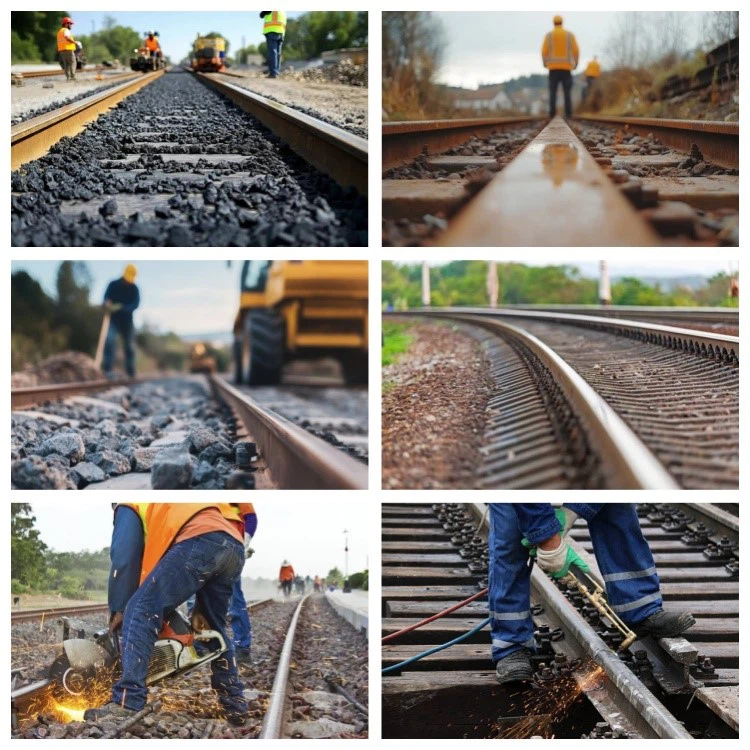
About guardrails and guardrail shuttles
Railway guardrails are equipment installed on railway tracks, mainly used to protect and guide trains and ensure the safety and efficiency of railway traffic. The guardrails laid on the main line should generally not be less than 38 kg/m. The guardrail shuttle is located at the tail end of the guardrail, and its main function is to protect the track and prevent trains from derailing.
1. Purpose of guardrails and guardrail shuttles
(1). Protection function: guardrails can prevent trains from leaving the track, avoid derailment accidents, provide boundaries and support, and ensure that trains run stably on the railway.
(2). Guidance function: guardrails can guide trains to run on the correct track and avoid derailment.
(3). Separation function: in a complex railway network, guardrails can separate tracks of different routes to ensure that trains run on different lines.
(4). Auxiliary function: signal equipment, communication equipment, and train control equipment are usually set on the guardrails to assist train travel and communication.
(5).Guard rail shuttle: Guard rail shuttles have various specifications, the most common ones are 43KG, 50KG, 60KG, etc., and there are also type II and III rail sleeper shuttles.
2. Types of guard rails and their differences
Guard rails can be divided into various types according to the laying location and function, mainly including:
(1). Turnout guard rails: Turnout guard rails are mainly laid at the turnout fork. Their function is to restrict the running direction of the wheels, so that they can safely pass through the "harmful space" and prevent the wheels from going to the opposite side or colliding with the heart rail.
(2). Bridge guard rails: Mainly laid on bridges, mainly used to prevent trains from overturning after derailment on bridges, reducing the harm of secondary accidents.
(3). Curve anti-wear guard rails: Laid on the inner side of the inner rail of a small radius curve, constrain the wheels and reduce the wear on the side of the outer rail.
(4). Curve anti-derailment guard rails: Generally used in scenes such as subways with high linear differential speeds, it prevents wheels from derailing by limiting the lateral movement of the axle by pressing the inner side of the wheel.
(5). Crossing guardrail: It is laid at the crossing and adopts the horizontal rail type. It consists of horizontal rails, guardrails, connecting plates, etc. to ensure smooth traffic.
Different types of guardrails differ in structure and function, but they are all aimed at ensuring the safety and efficiency of railway traffic.
3. Regulations for laying guardrails
(1). The top surface of the line guardrail should not be higher than the top surface of the line rail, nor should it be 25 mm lower than the line rail surface. The width between the outer side of the guardrail head and the inner side of the line rail head should be 200 mm, with an allowable increase or decrease of 10 mm.
(2). A longitudinal long pad with a thickness of less than 30 mm is allowed under the guardrail (a transverse pad can also be used for the ballast bridge deck). Two spikes should be nailed on every other bridge sleeper and on each line sleeper for each guardrail. When using a pad with a thickness of 20~30 mm, two spikes should be nailed on each bridge sleeper for each guardrail.
(3). Both ends of the bridge deck guardrail should extend beyond the abutment ballast retaining wall, and the length of the straight rail part should be no less than 5m: 10m for bridges with a length greater than 50m on a straight line and greater than 30m on a curve.
(4). The guardrail joints should be connected with joint clamps of the same rail type. At least 4 bolts should be installed on each guardrail joint, and the nuts should be installed on the outside of the wheel flange groove. In the automatic blocking section, an insulating pad should be installed at the junction of the guardrails.
(5). The width of the wheel flange groove of the crossing guardrail should not be less than 70mm on a straight line and not less than 90mm in the inner strand of the curve; the wheel flange groove depth is 45~60mm (not less than 45mm under any circumstances). Both ends of the guardrail are made into flares, bending to the center of the line at 300mm from the rail end, and its terminal is not less than 150mm from the working edge of the rail.
(6). The turnout guardrail is laid according to the dimensions specified in the turnout design drawing.