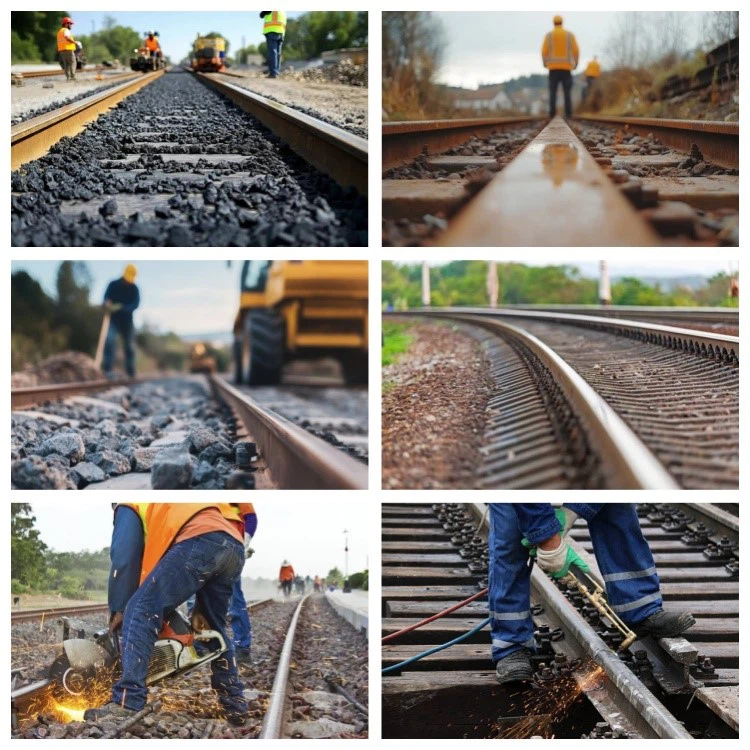
Conventional Railway Fastener Models
As an important component in the railway track structure, conventional railway fasteners are mainly used to fix rails to ensure the stability and safety of the track. The following are the main models, types and characteristics of conventional railway fasteners:
1. Spring clip fasteners
Spring clip type I fasteners: This is one of the commonly used fastener types in low-speed railways. Its characteristics include simple structure, easy installation, and sufficient strength and durability. Spring clip type I fasteners are mainly composed of threaded spikes, nuts, flat washers, spring clips, gauge baffles, baffle seats and rubber pads. The spring clips are used to elastically buckle the rails, and the rubber pads are used to buffer the vibration impact between the wheels and rails and provide vertical elasticity.
Other spring clip types: such as type II, type III, W series (W1, W2, W4, etc.) spring clip fasteners. These fastener types have their own characteristics in structure and performance, but all have high strength and durability, and are suitable for different low-speed railway lines and environmental conditions.
2. Other types of fasteners
Pinch plate fasteners: This type of fastener uses a gusset as the main component for fixing the rails, and has the characteristics of simple structure, easy installation and maintenance. However, in low-speed railways, the use of gusset plate fasteners is relatively rare, and is more common in certain specific scenarios or old lines.
Arch spring fasteners: Arch spring fasteners fix the rails through the elastic deformation of the arch springs, and have high clamping pressure and stability. But similarly, their application in low-speed railways is also relatively limited.
3.Features
(1)Reliable structure: The structural design of low-speed railway fasteners is reasonable, which can ensure stable fixing effect during long-term operation and reduce safety hazards caused by loosening or falling off.
(2)Convenient installation: Most low-speed railway fasteners adopt modular design, and the installation process is simple and fast, which reduces the difficulty and cost of construction.
(3)Vibration reduction and noise reduction: Components such as rubber pads in low-speed railway fasteners have good vibration reduction performance, which can effectively reduce the vibration and noise during train operation and improve passenger comfort.
(4)Strong adaptability: Different types of low-speed railway fasteners can adapt to different line conditions and environmental requirements, such as small curve radius, uneven track and other complex situations, to ensure the safe operation of the railway.
It should be noted that with the continuous development and progress of railway technology, the models and types of low-speed railway fasteners are also constantly updated and upgraded. Therefore, in practical applications, they should be selected and used according to specific line conditions, transportation needs and environmental requirements.