


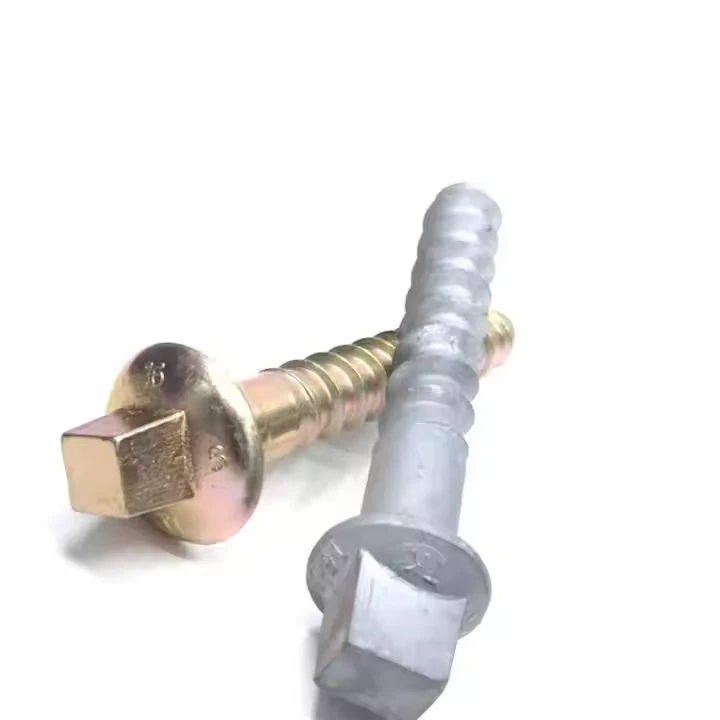

↵Rail Screw Spike Fastening System

The Railway Screw Spike is a threaded fastening component used to secure rails, baseplates, or sole plates to wooden or composite sleepers. It features a large, coarse-threaded shank topped by a square or hexagonal head for tool engagement. Unlike driven spikes, it is installed by rotation, generating axial clamping force through tension, offering a more secure and adjustable connection than traditional dog spikes.
Technical Specifications:
| Perspective | Core Principle | Key Advantage | Primary Application Context | Main Limitation |
|---|---|---|---|---|
| Mechanical & Installation | Threaded Tensile Fastening | Reusable, Adjustable, & Controlled Pre-load | Tracks Requiring Secure but Demountable Fixation | Requires Torque Control & Specialized Tools |
| Performance & Application | Enhanced Stability via Baseplate | Superior Pull-Out Resistance & Gauge Holding | Mainline & Heavy-Haul Tracks on Timber/Composite Sleepers | Not an Elastic Fastener (Higher Dynamic Load Transfer) |
| Economic & Lifecycle | Balanced CapEx/OpEx Solution | Lower Maintenance than Dog Spikes, Higher Performance | Network Upgrades & Cost-Sensitive Heavy-Duty Applications | Higher Initial Cost & Tooling Investment vs. Dog Spikes |

Functional & Engineering Perspective
Threaded Engagement Mechanism: Generates holding power through mechanical interlock between its coarse, deep threads and the surrounding material (wood or composite), providing superior pull-out resistance compared to friction-based spikes.
Controlled Installation Torque: Requires application of a specific installation torque using manual or powered wrenches, allowing for standardized pre-tensioning and consistent clamping force across all fasteners.
Axial Clamping Force: The tension created in the spike shank applies a direct downward clamping force, pressing the rail/baseplate firmly against the sleeper surface, enhancing stability.
Maintenance & Operational Perspective
- Enhanced Restraint & Stability: Provides greater longitudinal (creep) and lateral restraint than dog spikes, leading to better gauge retention and track geometry stability, suitable for moderate-speed mainlines.
- Primary Use with Steel/CI Baseplates: Commonly used in conjunction with a steel or cast iron baseplate (or sole plate), which distributes the rail load over a larger sleeper area, protecting the timber.
- Compatibility with Timber & Composite Sleepers: Remains the fastener of choice for heavy-haul and mainline tracks utilizing hardwood timber sleepers or modern polymer/composite sleepers where elastic clips are not applicable.

Gnee Professional supplier


Hot Tags: rail screw spikes fastening system, China rail screw spikes fastening system manufacturers, suppliers, factory, maintenance free rail spikes, small scale rail spikes production, affordable rail spikes, railway spikes workshop, large scale rail spikes production, efficient rail spikes production


