

How does the 136re rail cross section area improve load capacity?
The 136RE rail cross section area improves load capacity by increasing the amount of material available to resist stress, bending, and fatigue under heavy axle loads, allowing the rail to distribute wheel forces more evenly and maintain structural stability in demanding railway operations. In simple terms, a larger and optimized 136RE rail section means higher strength, lower deformation, and better long-term performance under repeated loading.
The 136RE rail (also known as 136 lb rail, 136 pound rail, AREMA 136RE rail) is standardized by AREMA, with a typical 136RE rail weight of 136 lbs per yard (≈67.5 kg/m) and a well-balanced 136RE rail profile designed for heavy-duty railway systems.
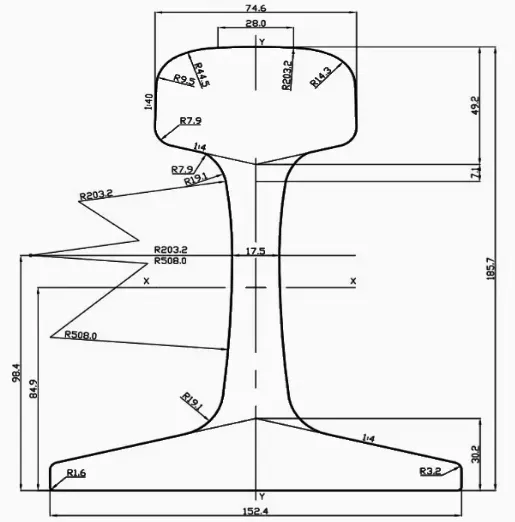
| Profile | Standard | Dimensions mm | Section S | Mass m | ||||
|---|---|---|---|---|---|---|---|---|
| H | B | C | D | E | cm² | kg/m | ||
| American standard | ||||||||
| 136RE (TR68) | AREMA | 185,70 | 152,40 | 74,60 | 49,20 | 17,50 | 85,90 | 67,50 |
GNEE RAIL supplies AREMA 136RE rail with controlled geometry and consistent mechanical properties to ensure stable performance in high-load environments.
Why a Larger Cross Section Area Directly Increases Load Capacity?
A larger 136RE rail cross section area increases load capacity because it reduces stress intensity and increases the material volume available to resist external forces. In railway engineering, this is one of the most fundamental principles governing rail strength.
-
Stress reduction mechanism
Stress is defined as force divided by area. When the 136RE rail section has a larger cross section, the same wheel load generates lower internal stress, improving structural safety margins.
-
Higher load-bearing limit
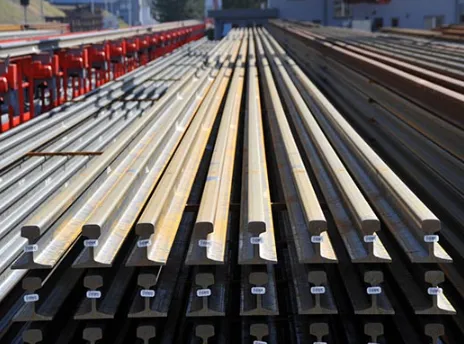
The increased material volume in the 136 RE steel rail allows it to withstand higher axle loads without reaching plastic deformation, making it suitable for heavy haul corridors.
-
Engineering value in real systems
In real railway networks, this means fewer deformation risks, better track geometry retention, and longer maintenance intervals.
How the 136RE Rail Section Improves Bending Resistance?
The bending resistance of the 136RE rail section depends on how material is distributed relative to the neutral axis, which directly affects stiffness under vertical loading.
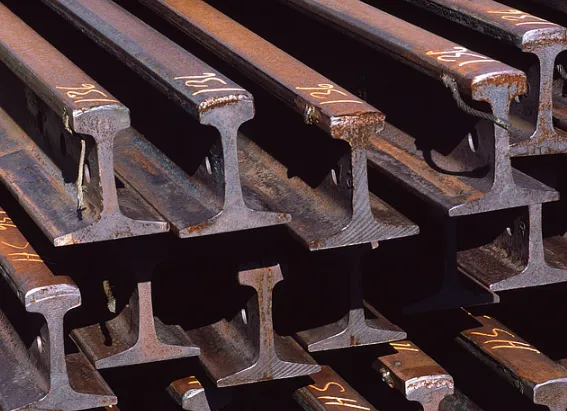
The geometry of the 136RE rail profile increases the moment of inertia by placing more material away from the neutral axis. This significantly improves resistance to bending deformation under passing trains.
The 136RE rail height (~185–186 mm) further enhances vertical stiffness, reducing deflection and helping maintain stable track geometry over long-term operation.
FAQ
1. Why does cross section area improve load capacity?
A larger cross section reduces internal stress under the same load, improving structural strength and safety margin.It also allows better distribution of wheel forces across the rail body. This helps prevent deformation in heavy haul applications.
2. How does 136RE rail handle heavy loads?
The 136RE rail section distributes stress more evenly across head, web, and baseThis reduces localized deformation and improves stability under high axle loads. It is widely used in freight and heavy haul systems.
3. Why is 136RE rail suitable for heavy haul systems?
Its large cross section and high stiffness allow it to withstand repeated heavy loading cycles.This reduces long-term wear and ensures stable track geometry under continuous freight operations.
4. Does rail height affect performance?
Yes, 136RE rail height (~185–186 mm) significantly improves bending resistance.Higher rail geometry increases stiffness and reduces vertical deflection under load.
5. Can it reduce maintenance requirements?
Yes, better stress distribution reduces surface wear and fatigue damage.This extends maintenance intervals and lowers overall lifecycle maintenance costs.
The improvement in load capacity is fundamentally driven by the increased and optimized 136RE rail cross section area, which enhances stress resistance, bending stiffness, and fatigue performance. This structural advantage is why AREMA 136RE rail is widely used in heavy-duty railway systems worldwide.
For project specification or pricing support, you can Get a Quote in 24 Hours.


