

Do standard 136 lb rail dimensions fit legacy joint bars?
The short answer is: It depends entirely on the specific legacy section you are replacing. While the 136RE (136 lb) rail is the modern standard, its compatibility with legacy joint bars (fishplates) is often restricted by subtle differences in "fishing height"-the vertical space between the rail head and base where the joint bar seats.
Here is a detailed breakdown of compatibility with the most common legacy sections.
1. Compatibility with 132RE and 133RE (High Compatibility)
The 136RE was specifically designed as a "descendant" of the 132RE and 133RE profiles.
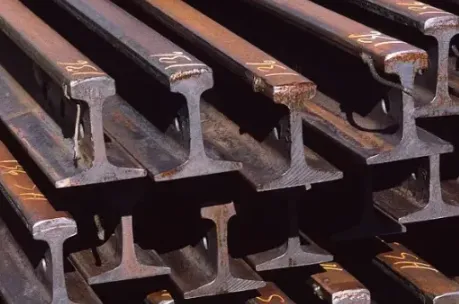
- The Fit: 136RE shares the same 6-inch base and 7-5/16-inch total height as the 132RE and 133RE.
- Joint Bar Usage: Because the "fishing" dimensions (the slope and distance between the head and base) are nearly identical, modern 136RE joint bars are generally interchangeable with 132RE and 133RE sections.
2. Compatibility with 115RE and 119RE (No Compatibility)
Standard 136 lb rail dimensions will not fit joint bars designed for 115 lb or 119 lb rail.
• Dimension Gap: The 115RE rail is only 6 – 5/8 inches tall with a 5 – 1/2 inch base.
• Fishing Height: The vertical gap in a 115RE joint bar is significantly smaller than that of a 136RE. Attempting to force a 115 lb bar onto 136 lb rail will result in a "loose fit" that cannot be bolted safely, leading to joint failure.
3. The "Fishing" Problem with Older Legacy Rails (Pre-1950s)
If you are working with very old legacy rails (such as 130 lb PS or 131 lb RE), the 136RE dimensions will likely cause fitment issues.
• Head Geometry: The 136RE has a much thicker head (1 – 15/16 inches) than older 130 lb sections.
• Bolt Hole Alignment: Legacy joint bars often have different bolt hole spacing or vertical alignments (the "neutral axis"). Even if the bar physically seats into the fishing area, the holes in the rail and the bar may not line up.
4. Solutions for Mismatched Dimensions
When standard 136 lb dimensions do not match legacy joint bars, engineers use two primary solutions:
- Compromise Joint Bars (Step Bars): These are specialty cast or forged bars designed with a "step" in the middle. One half fits the 136RE profile, while the other half is molded to fit the legacy (e.g., 115RE or 131RE) profile.
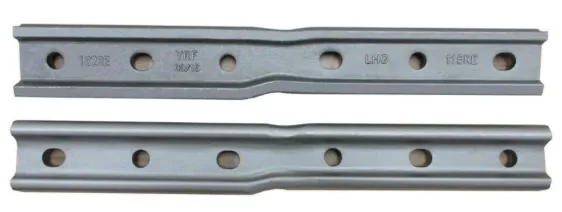
- Transition Rails: A short section of rail is forged or machined to taper from one profile to the other, which is then welded into the track, allowing standard joint bars to be used on either end.
What Is the Recommended Approach for 136RE Rail Connections?
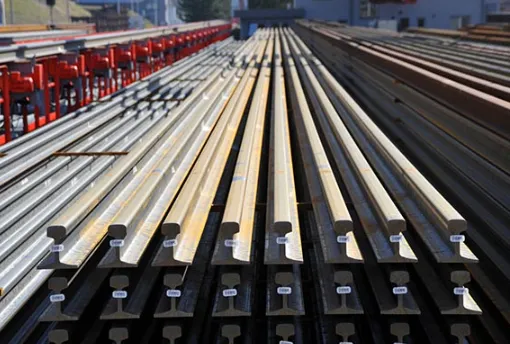
For reliable performance, joint bars should be specifically designed for the AREMA 136RE rail section.
Matching joint bars ensure correct fit with the 136RE rail cross section area, proper load distribution, and secure bolt fastening. This reduces the risk of joint failure and extends the service life of both the rail and connection components.
For projects involving replacement or upgrades, it is advisable to confirm compatibility early. You can Talk to Our Engineer to review your existing joint bar specifications against 136RE rail dimensions.
FAQ
1. Can 136RE rail use old joint bars?
Not directly in most cases. Differences in 136RE rail dimensions and hole spacing often require matching joint bars designed for this profile.
2. What causes incompatibility between rail and joint bars?
Key factors include mismatched rail profile, bolt hole spacing, and differences in rail height and web thickness.
3. Is it safe to modify legacy joint bars?
Modification is possible but not always recommended, as it may reduce structural strength and fatigue performance.
4. What joint bars should be used with 136RE rail?
Joint bars specifically designed for AREMA 136RE rail should be used to ensure proper fit and load distribution.
5. How do I confirm compatibility before installation?
Check technical drawings, hole spacing, and rail section details. Engineering review is recommended.
6. Does 136RE rail require special fasteners?
Yes, fastening systems should match the 136RE rail section to ensure proper clamping force and stability.
7. Can GNEE RAIL provide matching components?
Yes, matching joint bars and fastening systems can be supplied along with 136RE rail to ensure full compatibility.
Standard 136 lb rail dimensions are not universally compatible with legacy joint bars due to differences in rail profile, hole spacing, and section geometry. Ensuring proper matching between 136RE rail and joint bars is critical for safety and long-term performance.
GNEE RAIL supports rail supply along with matching joint bars and fastening systems to help avoid compatibility issues. For detailed specifications or project evaluation, you can Get a Quote in 24 Hours.


