

Which Steel Grades are Best for Manufacturing uic54?
UIC54 rail (also known as 54E1 rail or rail 54E1) is manufactured using carefully selected steel grades that meet UIC 860 / EN 13674-1 standards. The "best" steel grade is not a single fixed option. It depends on how the rail will be used, including axle load, traffic frequency, and maintenance expectations.
uic54 rail specification:
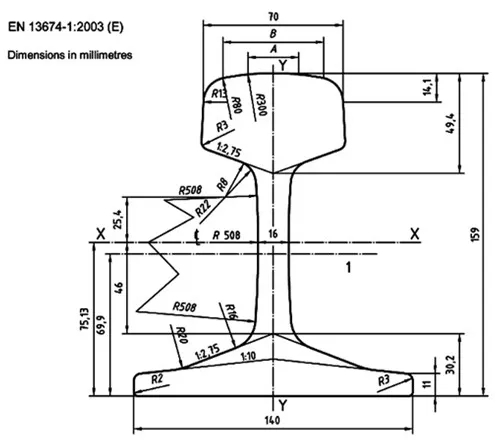
| Type of Rail | Dimensions mm | Steel Grade | Weight(Kg/m) | |||
| Rail height/A | Bottom Width/F | Head Width/C | Web Thickness/t | |||
| 54E1 (UIC54) | 159 | 140 | 70 | 16 | R200 / R260 / R260Mn / R300HT | 54.77 |
| 60E1 (UIC60) | 172 | 150 | 72 | 16.5 | R200 / R260 / R260Mn / R300HT | 60.21 |
For most railway projects, the commonly recommended grades are R260, R300, R350HT, and U71Mn. Each of these grades offers a different balance of strength, hardness, wear resistance, and cost, allowing the UIC54 rail profile to perform effectively in different operating environments. At GNEE RAIL, these grades are produced with controlled rolling and heat treatment to ensure stable mechanical performance and full compliance with UIC54 rail specification.
How Do Common Steel Grades Perform in UIC54 Rail?
The following grades are widely used in manufacturing UIC54 rail profile, each serving a specific application range.
- R260 is the most widely used grade for standard railway lines. It offers reliable strength and good toughness, making it suitable for general passenger and freight traffic. It is also cost-effective, which makes it ideal for large-scale infrastructure projects where budget control is important.
| R260 | Mechanical Property | Chemical Composition | |||||||||||
| Yield strength | Tensile strength | Elongation | Hardness | C | Si | Mn | S | P | H ppm | O ppm | |||
| MPa | kg/mm² | MPa | kg/mm² | min | HB | ≤ | ≤ | ≤ | ≤ | ||||
| ≥880 | 10% | 260-300 | 0.62-0.80 | 0.15-0.58 | 0.70-1.20 | 0.025 | 0.025 | 2.5 | 20 | ||||
- R350HT is a heat-treated high-strength grade. It has significantly higher hardness, which improves resistance to rail head wear and rolling contact fatigue. This makes it the preferred option for heavy-haul railways, high-speed lines, and curved tracks where wear is more severe.
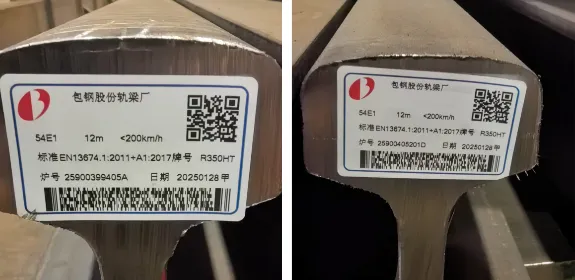
| R350HT | Mechanical Property | Chemical Composition | |||||||||||
| Yield strength | Tensile strength | Elongation | Hardness | C | Si | Mn | S | P | H ppm | O ppm | |||
| MPa | kg/mm² | MPa | kg/mm² | min | HB | ≤ | ≤ | ≤ | ≤ | ||||
| ≥1175 | 9% | 350-390 | 0.72-0.80 | 0.15-0.58 | 0.70-1.20 | 0.025 | 0.020 | 2.5 | 20 | ||||
Each of these materials can be used to manufacture UIC54 rail, but their performance will vary depending on operating conditions.
Which Steel Grade Should You Choose for Your Project?
Selecting the best steel grade for UIC54 rail (54E1 rail) requires matching material properties to actual service conditions. For standard railway lines with moderate loads and traffic, R260 or U71Mn is usually sufficient and offers good cost control.
For lines with higher traffic frequency or increased wear conditions, R300 provides a stronger and more durable option without a major increase in cost. When the railway operates under heavy axle loads, high speeds, or requires extended service life with reduced maintenance, R350HT becomes the most suitable choice due to its superior hardness and fatigue resistance.

The key is to avoid over-specification or under-specification. Choosing a grade that is too high may increase cost unnecessarily, while choosing a lower grade may lead to faster wear and higher maintenance costs over time.
What Makes a Steel Grade "Best" for UIC54 Rail?
Before comparing specific grades, it is important to understand the criteria used to evaluate them. Rails are exposed to continuous wheel contact, impact loading, and cyclic stress. If the steel is too soft, the rail head will wear quickly. If it is too hard without sufficient toughness, it may crack under dynamic loads.
The ideal material for rail 54E1 must achieve a balance between wear resistance and fatigue strength, while maintaining enough ductility to absorb impact. In addition, the steel must be suitable for rolling into the precise UIC54 rail dimensions without internal defects.
Because different railway lines operate under different conditions, the "best" grade is always the one that matches the actual working environment rather than simply having the highest strength.
FAQ
- What is the most commonly used steel grade for UIC54 rail?
R260 is the most widely used due to its balance of performance and cost.
- Is R350HT the best choice for all projects?
No. It is best for heavy-haul and high-wear conditions, but may not be necessary for standard lines.
- Does higher hardness always mean better performance?
Not always. Excessive hardness without toughness can increase the risk of cracking.
- Can different grades be used in the same railway project?
Yes. Different sections may require different performance levels.
- How do I choose the right grade for UIC54 rail?
It depends on axle load, traffic frequency, speed, and maintenance strategy.
GNEE RAIL manufactures UIC54 rail and 54E1 rail profile in multiple steel grades including R260, R300, R350HT, and U71Mn, ensuring full compliance with international standards. We control chemical composition, rolling process, and heat treatment to deliver stable performance and accurate UIC54 rail dimensions. With flexible grade selection and processing options, we help match the right material to your project conditions. If you need technical data or recommendations, you can contact us to get UIC54 rail material solutions, and we will provide the most suitable option based on your requirements.


